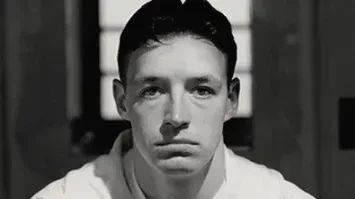
No one accepts an invitation to a high school friend’s house to "party" imagining it will change the course of their life forever. Yet that is exactly what happened to Randy Wood. In 1996, at just 17 years old, he went to a friend's house, unaware that the events that were to follow would lead to him spending the rest of his life in a Texas prison, serving a life sentence for a crime he did not commit.
Randy is now 47 years old and has spent 30 years incarcerated in Texas Department of Criminal Justice (TDCJ), convicted of Capital Murder under Texas’ Law of Parties. Law of Parties allows a person to be held criminally responsible for the actions of another person, even if they did not personally commit the act itself.
Prior to trial, Randy was offered a plea deal that would have required him to plead guilty to murder in exchange for the possibility of parole after 30 years. He declined on a matter of principle, maintaining that he had not committed murder and therefore would not plead guilty to murder.
Randy then testified for the prosecution in one of his co-defendants’ trials. By doing so without a plea agreement in place, he risked receiving a far more severe sentence, including the death penalty, which remained a legal option at the time. He believed that if he accepted a plea deal before testifying, the defense would argue that his testimony was motivated by the benefits he had received rather than by the facts of the case.
Both of Randy's co-defendants alleged that he was the person who shot the victim. However, investigators were unable to find evidence that corroborated their account. Randy also agreed to undergo a polygraph examination and passed, whereas his co-defendants did not. In October 1998, a jury convicted Randy of Capital Murder under the Law of Parties, despite there being no evidence that he had planned or participated in the killing. The conviction carried a mandatory life sentence, making him eligible for parole only after serving 40 years.
In mid-2026, Randy received information that would fundamentally change his understanding of what happened in his case. The District Attorney who prosecuted him, Tim Cole, and the Texas Ranger who led the original investigation, visited him in prison while researching the book they are writing about Heather’s murder, that will be published late 2027. They wanted his input because they trusted his account of events. During their conversation, Mr. Cole mentioned that before trial he had offered Randy a plea agreement for conspiracy. It was the first time Randy had ever heard of such an offer. Had the plea deal been presented to him, he would have accepted it without hesitation and avoided the much harsher sentence he ultimately received. Randy’s attorney, a former prosecutor, failed him in so many ways.
Learning this has opened a potential legal avenue that was not previously available. Under the U.S. Supreme Court's decision in Missouri v. Frye (2012), a defendant may have grounds to challenge a conviction when a formal plea offer was not communicated by their attorney. Having received a legal opinion based on the information at hand, it is believed he has grounds to file an 11.07.
After spending 30 years in prison for a crime he didn’t commit, Randy finally has an opportunity to seek review of a critical part of his case. We are asking for your help to cover the $3,500 for a comprehensive case review, where the legal team will gather and analyze all records, obtain affidavits, review the details of the case, and from this information they will outline viable legal options, along with the strengths, challenges, and likelihood of success should the process go forward.
Randy should not still be incarcerated. After nearly three decades behind bars, he has paid an extraordinary price and deserves the opportunity for a second chance at life. Throughout his imprisonment, he has demonstrated exemplary behavior, earning more than 70 years of good-time and work-time credits that reflect his commitment to personal growth, responsibility, and rehabilitation. By every measure, he has proven himself to be a model prisoner. Yet without this critical legal avenue, Randy faces spending at least another decade in prison. We believe justice should allow room for redemption, and Randy deserves the chance to finally come home and rebuild his life.
In an interview with the lead investigator on the case, Texas Ranger Lane Akin said, “Josh Bagwell never confessed. He denied to the very, very end. He never felt badly about participating in the murder. He provided the shotgun shells. He provided the alcohol. He provided the pickup. He provided the MEANS to commit the murder. Curtis Gamble is the absolute epitome of evil. Gamble was the murderer. Josh Bagwell was his assistant. If there is anyone in the group who has any mitigating qualities, it would be Randy Wood. He lamented the fact that he was involved. Randy Wood was just there and didn’t have the courage to stop it.”
No one deserves a life in prison for lacking courage.
If you want to know more, read these articles linked below.
https://www.texasmonthly.com/true-crime/a-bend-in-the-river/
https://www.texasmonthly.com/true-crime/a-question-of-mercy/
In October 1996, I began following the case of the kidnapping and murder of Heather Rich. Heather was a 16-year-old girl from Waurika, Oklahoma, who disappeared on October 2, 1996. Her body was discovered a week later, on October 9, beneath the Belknap Bridge in Montague County, Texas.
For nearly three decades, I have followed this case closely. It is a case that has stayed with me, one that I have never been able to let go of.
The crime itself was tragic and devastating. Heather's life was taken far too soon, and her family suffered an unimaginable loss. Nothing can diminish the pain endured by Gail and Dwayne Rich, who were forced to bury their daughter and live with the consequences of that loss.
Randy is the reason I have remained engaged with this case for so many years. In October 2026, he will have spent 30 years in the Texas prison system. After reviewing the trial testimony, investigative records, media coverage, and available transcripts, I have reached the conclusion that there is no evidence showing Randy personally murdered Heather Rich. What continues to trouble me is how a teenager who did not fire the weapon, was not shown to have planned the murder, and willingly testified for the prosecution, remains incarcerated three decades later.
The day Randy was convicted and sentenced to life imprisonment was August 25, 1998, the same day I gave birth to my second daughter. I remember learning of the verdict and was devastated by the outcome.
Over the years, I have watched the portions of the trial that were broadcast publicly, reviewed news and magazine coverage, documentaries, and read the available court records and transcripts. The more I learned about the case, the more convinced I became that Randy's level of culpability was fundamentally different from that of the two young men who planned and carried out the crime. According to the evidence presented at trial, Curtis Gambill was the individual who carried out the murder. Joshua Bagwell played a significant role in the events leading up to it.
There is no dispute that Randy was present on the night Heather was murdered. He doesn’t deny he was there. He is guilty of being in the wrong place at the wrong time, of being too afraid to try and stop Curtis Gambill from firing his shotgun 9 times and murdering Heather Rich in cold blood. That failure had devastating consequences, but it is not the same as committing the murder itself. There’s no doubt in my mind that Curtis would have killed Randy that night as well, had he possessed the courage to intervene.
After 30 years, Randy has paid his debt to society and deserves to have his sentence reconsidered.