
No Water on Ridgeview
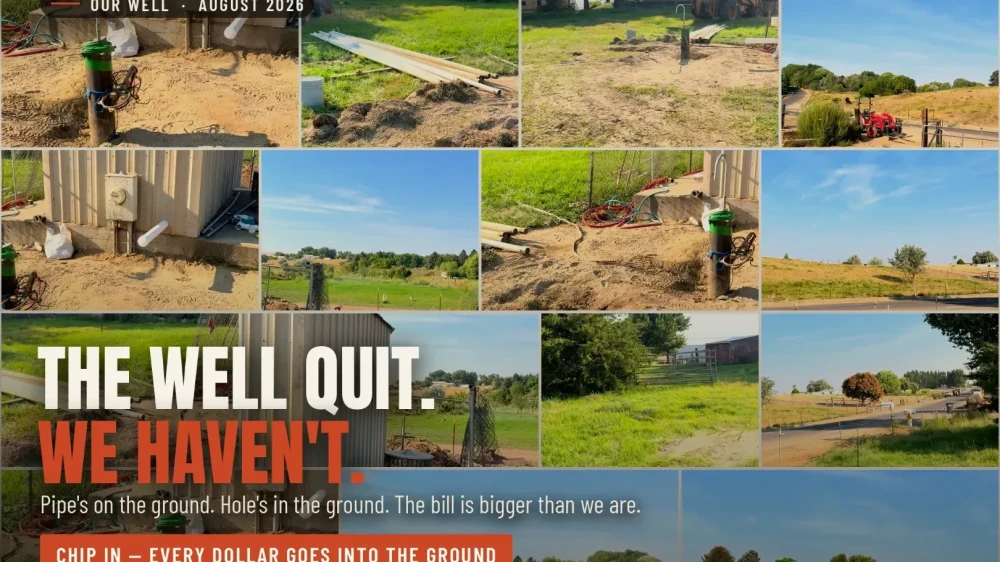
No Water on Ridgeview
For forty-seven years, the people served by this Association have lived with a water system they could not fully depend on.
Not every day has been a crisis. It means water has never faded into the background of daily life the way it should. Pressure has fallen away for hours, with no real stored reserve to carry the neighborhood through a failure. When the source cannot run, the problem reaches everyone connected to it.
There are 25 active connections serving about 79 people. That can look small on paper. It is not small to those whose homes share the same source, lack of reserve, and uncertainty.
The system was designed in 1978 and built in 1979. It was built as designed, but the design followed the money available at the time. It did not have the redundancy and storage needed to absorb a major failure decades later.
Well One became the permanent source. Well Two was an emergency source, not a dependable second well carrying the system alongside the first. Today there is no distribution storage and no pressure tank in service to bridge the gap when a well goes down.
For five years, I warned our Board that Well One was failing. I was not trying to assign blame. Small associations work with limited money, volunteer time, old records, and decisions that rarely come with a simple answer. But I could see that we were running out of margin. If Well One failed before we had a real plan, the whole community would be left without an easy fallback.
That is where day one of this emergency began.
Our primary well went down, and the Association lost normal water service. A problem the community had lived around for years became an emergency it could no longer work around. At first, the visible problems were a damaged pipe and a failed motor. It would have been easier if that were the whole story: replace the equipment and move on.
But dirty water and formation material came from Well One, and the old records did not line up cleanly with what we found. The question was no longer just how to replace a pump. It was whether the well could be rehabilitated or more spending would only postpone another failure.
Every option costs money, and the Association cannot afford to spend its way through guesses. Meanwhile, the community still had no dependable return to normal water.
We looked to Well Two, but it was an emergency source with an uncertain condition. Work brought back dirty water and loose material, and its pump seized. I will not call it collapsed without physical evidence. It did not become the backup we needed. We had two wells with separate problems, no reserve, and no clear path back to normal service.
The response became a race on several fronts: understand the wells, find lawful temporary water, keep members informed, coordinate contractors, and search for money.
Well One’s failed equipment was pulled and preserved. It was not stuck in the bore, but a major water-level change raised a question about the casing. We needed a camera inspection before deciding what to do next.
We also looked for temporary water. The fire district could not deliver potable water. The city lacked a large enough truck but offered hydrant access if lawful hauling could be arranged. We contacted health, emergency, and rural-water organizations. An approved source, safe hauling, operator oversight, disinfection, sampling, records, and notice all had to be coordinated. No single call could do that.
A bilingual notice went out late that first week. It said Well One was out, Well Two was unavailable for regular use, and funding work had begun. It could not say when dependable water would return. An agency email mixed facts from the wells. We corrected it: Well Two was not operating, hauling was still under investigation, and the sample belonged to Well One.
With both sources unavailable, outreach widened. USDA asked about Well One and our eligibility. We contacted a rural lender. Evergreen Rural Water helped begin membership and income-survey work. The Department of Health said one emergency-loan route could take four to six months and required additional findings before an invitation to apply. None provided immediate water.
During the second week, a temporary pump in Well One produced some water but repeatedly locked up or carried substantial sand. Some water was not dependable water. A boil-water and emergency-use notice went out. This was not a permanent restoration.
Work at Well Two remained separate. Water was removed from the sump area, and plumbing into the Association system was sealed off. That reduced one possible contamination path but did not establish that Well Two was usable.
The Board directed us to gather evidence before spending more. The wrong repair would leave us worse off. Well One’s temporary equipment came out for camera work. A truck tried to pull Well Two’s equipment but lacked enough lifting capacity. A larger truck was being sought, subject to Board direction. The attempt proved nothing about the well.
Water and funding work continued, but no county declaration appeared in the record. USDA had not issued a written eligibility decision, the lender had not decided, and federal requirements remained unfinished. The community could not wait for bureaucracy to become simple, so the work continued inside it.
The work has been shared. Judi and the operators handled operations and coordination. Julie took the failed chlorinator pump for repair. Corey provided rural-water support. Contractors adapted, and the Board made decisions without the certainty anyone would prefer. People kept taking the next step without knowing which would bring dependable water back.
My role kept me in field and electrical work, with contractors and records, delivering notices, making calls, correcting information, and tying decisions to evidence. I worked twelve of the first thirteen days, roughly fourteen to nineteen hours a day. I say that without taking away from anyone else’s work. It shows the strain of doing all this in a community with no reserve.
At the end of two weeks, Well One needed camera evidence before more money was committed. Well Two needed suitable equipment and physical investigation before anyone could call it usable or lost. Temporary water, engineering, and funding work had to continue. We had better questions, but not the certainty the community needed.
Separate from this domestic-water emergency, our members’ continued access to irrigation water is also at risk. The East Columbia Basin Irrigation District notified us in May that our current interruptible contract will terminate before the 2027 season and that a different federal contract will be required to continue project-water delivery. We have paid the application fee, but no replacement contract has been signed, and questions about the orchards, crops, pasture, and livestock served by the system remain unresolved. It is a different issue, but another serious uncertainty for the same community.
We still do not have a dependable source in normal operation. Well One needs investigation before more money is committed. Well Two cannot be called usable or lost until it is physically investigated. Temporary water, engineering, documentation, funding eligibility, and approval remain part of the path ahead.
The community needs more than a way to turn the water back on for a few days. After forty-seven years of living without enough margin, people need a system that does not turn one equipment failure into a community-wide emergency.
We need two dependable municipal-grade sources, so the whole community is not resting on one well. We need stored water that gives the system time and resilience. We need the pumping, treatment, controls, and distribution work required to deliver water reliably rather than operating at the edge of failure.
That is the future I am asking people to help us build.
Our first working campaign target is $50,000. That supports the immediate investigation, camera work, engineering, equipment evaluation, contractor work, and the next step justified by the evidence. It does not promise that a particular repair will succeed.
A total of $750,000 would move the Association into engineering, source work, deposits, and early mobilization.
Approximately $2 million is the current owner-managed planning target for rebuilding the system without storage.
A $2.75 million milestone adds storage and resilience, including a reserve concept of roughly 110,000 gallons and the infrastructure needed to use it.
A $3 million stretch concept would allow advanced treatment to be evaluated as part of the engineered system.
These are planning targets, not bids or guarantees. The final path depends on what the investigations show, what an engineer designs, what regulators approve, what contractors price, and what the Board authorizes.
I cannot promise which existing well, if either, will prove usable. I cannot give a responsible completion date before the evidence and engineering are in place. Public funding has not been secured. Donations are tax-deductible to the extent allowed by law, consistent with the Association’s registered 501(c)(3) status.
What I can say is that about 79 people should not have to continue living around a water system with no margin for failure.
This Association inherited a system built to the limits of an old budget. The people here have carried those limits for forty-seven years. Now the failure is in front of us, and so is the chance to stop repeating it.
If you are able to donate, share this campaign, or connect the Association with qualified help, you can help this community move beyond another temporary fix and toward water people can finally depend on.
Updates
Prayer Requests
Click the Pray button to let the fundraiser owner know you are praying for them.
No Water on Ridgeview
Fundraiser created byJake Richardson
Recent Donations
No Water on Ridgeview
Fundraiser created byJake Richardson
No Water on Ridgeview
For forty-seven years, the people served by this Association have lived with a water system they could not fully depend on.
Not every day has been a crisis. It means water has never faded into the background of daily life the way it should. Pressure has fallen away for hours, with no real stored reserve to carry the neighborhood through a failure. When the source cannot run, the problem reaches everyone connected to it.
There are 25 active connections serving about 79 people. That can look small on paper. It is not small to those whose homes share the same source, lack of reserve, and uncertainty.
The system was designed in 1978 and built in 1979. It was built as designed, but the design followed the money available at the time. It did not have the redundancy and storage needed to absorb a major failure decades later.
Well One became the permanent source. Well Two was an emergency source, not a dependable second well carrying the system alongside the first. Today there is no distribution storage and no pressure tank in service to bridge the gap when a well goes down.
For five years, I warned our Board that Well One was failing. I was not trying to assign blame. Small associations work with limited money, volunteer time, old records, and decisions that rarely come with a simple answer. But I could see that we were running out of margin. If Well One failed before we had a real plan, the whole community would be left without an easy fallback.
That is where day one of this emergency began.
Our primary well went down, and the Association lost normal water service. A problem the community had lived around for years became an emergency it could no longer work around. At first, the visible problems were a damaged pipe and a failed motor. It would have been easier if that were the whole story: replace the equipment and move on.
But dirty water and formation material came from Well One, and the old records did not line up cleanly with what we found. The question was no longer just how to replace a pump. It was whether the well could be rehabilitated or more spending would only postpone another failure.
Every option costs money, and the Association cannot afford to spend its way through guesses. Meanwhile, the community still had no dependable return to normal water.
We looked to Well Two, but it was an emergency source with an uncertain condition. Work brought back dirty water and loose material, and its pump seized. I will not call it collapsed without physical evidence. It did not become the backup we needed. We had two wells with separate problems, no reserve, and no clear path back to normal service.
The response became a race on several fronts: understand the wells, find lawful temporary water, keep members informed, coordinate contractors, and search for money.
Well One’s failed equipment was pulled and preserved. It was not stuck in the bore, but a major water-level change raised a question about the casing. We needed a camera inspection before deciding what to do next.
We also looked for temporary water. The fire district could not deliver potable water. The city lacked a large enough truck but offered hydrant access if lawful hauling could be arranged. We contacted health, emergency, and rural-water organizations. An approved source, safe hauling, operator oversight, disinfection, sampling, records, and notice all had to be coordinated. No single call could do that.
A bilingual notice went out late that first week. It said Well One was out, Well Two was unavailable for regular use, and funding work had begun. It could not say when dependable water would return. An agency email mixed facts from the wells. We corrected it: Well Two was not operating, hauling was still under investigation, and the sample belonged to Well One.
With both sources unavailable, outreach widened. USDA asked about Well One and our eligibility. We contacted a rural lender. Evergreen Rural Water helped begin membership and income-survey work. The Department of Health said one emergency-loan route could take four to six months and required additional findings before an invitation to apply. None provided immediate water.
During the second week, a temporary pump in Well One produced some water but repeatedly locked up or carried substantial sand. Some water was not dependable water. A boil-water and emergency-use notice went out. This was not a permanent restoration.
Work at Well Two remained separate. Water was removed from the sump area, and plumbing into the Association system was sealed off. That reduced one possible contamination path but did not establish that Well Two was usable.
The Board directed us to gather evidence before spending more. The wrong repair would leave us worse off. Well One’s temporary equipment came out for camera work. A truck tried to pull Well Two’s equipment but lacked enough lifting capacity. A larger truck was being sought, subject to Board direction. The attempt proved nothing about the well.
Water and funding work continued, but no county declaration appeared in the record. USDA had not issued a written eligibility decision, the lender had not decided, and federal requirements remained unfinished. The community could not wait for bureaucracy to become simple, so the work continued inside it.
The work has been shared. Judi and the operators handled operations and coordination. Julie took the failed chlorinator pump for repair. Corey provided rural-water support. Contractors adapted, and the Board made decisions without the certainty anyone would prefer. People kept taking the next step without knowing which would bring dependable water back.
My role kept me in field and electrical work, with contractors and records, delivering notices, making calls, correcting information, and tying decisions to evidence. I worked twelve of the first thirteen days, roughly fourteen to nineteen hours a day. I say that without taking away from anyone else’s work. It shows the strain of doing all this in a community with no reserve.
At the end of two weeks, Well One needed camera evidence before more money was committed. Well Two needed suitable equipment and physical investigation before anyone could call it usable or lost. Temporary water, engineering, and funding work had to continue. We had better questions, but not the certainty the community needed.
Separate from this domestic-water emergency, our members’ continued access to irrigation water is also at risk. The East Columbia Basin Irrigation District notified us in May that our current interruptible contract will terminate before the 2027 season and that a different federal contract will be required to continue project-water delivery. We have paid the application fee, but no replacement contract has been signed, and questions about the orchards, crops, pasture, and livestock served by the system remain unresolved. It is a different issue, but another serious uncertainty for the same community.
We still do not have a dependable source in normal operation. Well One needs investigation before more money is committed. Well Two cannot be called usable or lost until it is physically investigated. Temporary water, engineering, documentation, funding eligibility, and approval remain part of the path ahead.
The community needs more than a way to turn the water back on for a few days. After forty-seven years of living without enough margin, people need a system that does not turn one equipment failure into a community-wide emergency.
We need two dependable municipal-grade sources, so the whole community is not resting on one well. We need stored water that gives the system time and resilience. We need the pumping, treatment, controls, and distribution work required to deliver water reliably rather than operating at the edge of failure.
That is the future I am asking people to help us build.
Our first working campaign target is $50,000. That supports the immediate investigation, camera work, engineering, equipment evaluation, contractor work, and the next step justified by the evidence. It does not promise that a particular repair will succeed.
A total of $750,000 would move the Association into engineering, source work, deposits, and early mobilization.
Approximately $2 million is the current owner-managed planning target for rebuilding the system without storage.
A $2.75 million milestone adds storage and resilience, including a reserve concept of roughly 110,000 gallons and the infrastructure needed to use it.
A $3 million stretch concept would allow advanced treatment to be evaluated as part of the engineered system.
These are planning targets, not bids or guarantees. The final path depends on what the investigations show, what an engineer designs, what regulators approve, what contractors price, and what the Board authorizes.
I cannot promise which existing well, if either, will prove usable. I cannot give a responsible completion date before the evidence and engineering are in place. Public funding has not been secured. Donations are tax-deductible to the extent allowed by law, consistent with the Association’s registered 501(c)(3) status.
What I can say is that about 79 people should not have to continue living around a water system with no margin for failure.
This Association inherited a system built to the limits of an old budget. The people here have carried those limits for forty-seven years. Now the failure is in front of us, and so is the chance to stop repeating it.
If you are able to donate, share this campaign, or connect the Association with qualified help, you can help this community move beyond another temporary fix and toward water people can finally depend on.
Recent Donations
Updates
Prayer Requests
Click the Pray button to let the fundraiser owner know you are praying for them.
Fundraisers Near Me
GiverArmy Cause CURRENT EMERGENCIES
Our Current Emergencies cause is a fund uniquely set up to provide grants to qualifying campaigns on GiveSendGo.com.Grants Distribution is for:Pr...
Loading...
GiverArmy Cause ANIMAL RESCUE & CARE
Our Animal Rescue & Care cause is a fund uniquely set up to provide grants to qualifying campaigns on GiveSendGo.com.Grants Distribution:Prom...
Loading...

GiverArmy Cause ARTS & EDUCATION
Our Arts & Education cause is a fund uniquely set up to provide grants to qualifying campaigns on GiveSendGo.com.Grants Distribution:Supporting ar...
Loading...
GiverArmy Cause FAITH BASED
Our Faith-Based cause is a fund uniquely set up to provide grants to qualifying campaigns on GiveSendGo.com.Grants Distribution:Funding mission-o...
Loading...
GiverArmy Cause RESCUE & REHABILITATION
Our Rescue & Rehabilitation Cause is a fund uniquely set up to provide grants to qualifying campaigns on GiveSendGo.com.Grants Distribution:S...
Loading...
GiverArmy Cause EARTH CARE
Our Earth Care cause is a fund uniquely set up to provide grants to qualifying campaigns on GiveSendGo.com.Grants Distribution are for:Funding communi...
Loading...

GiverArmy Cause ESSENTIALS FOR LIFE
Our Essentials for Life Cause is a fund set up to provide grants to qualifying campaigns on GiveSendGo.com. Grants Distribution are designated to...
Loading...
GiverArmy Cause CRISIS RESPONSE
Our Crisis Response Cause is a fund uniquely set up to mobilize resources for need, creating direct Kingdom Impact, providing grants to qualifying cam...
Loading...
GiverArmy Cause JUSTICE FOR ALL
Our Justice for All Cause is uniquely set up fund that provide grants to qualifying campaigns on GiveSendGo.com.Grants Distributions are made to:Ensur...
Loading...
GiverArmy Cause MEDICAL RELIEF
Our Medical Relief Cause is our charitable fund set up to provide grants to qualifying campaigns on GiveSendGo.com.Grants Distribution from this...
Loading...
GiveSendGo
The place where help and hope go hand-in-hand.
