For more than two centuries, the Supreme Court has interpreted the Constitution’s taxing clauses through a framework built around “direct” and “indirect” taxes.
There is one striking problem:
The Constitution never uses the words “indirect tax” or "indirect taxes."
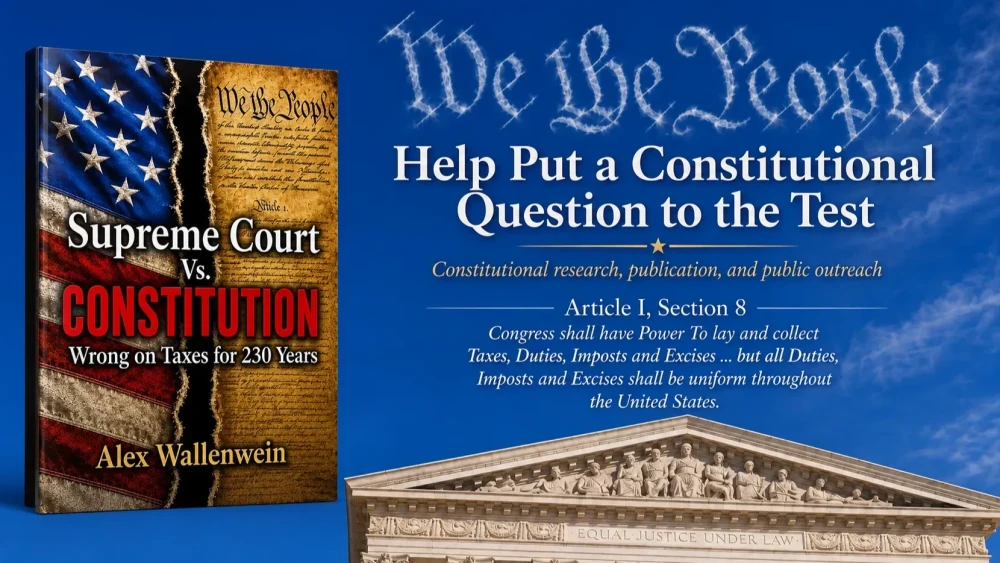
I am Alex Wallenwein, a legally trained independent constitutional researcher and author of Supreme Court vs. CONSTITUTION — Wrong on Taxes for 230 Years.
My research examines a surprisingly basic question:
Has the Supreme Court accurately interpreted the Constitution’s taxing clauses—or did the Court replace what the Constitution actually says?
That research has produced both a general-audience book and a separate scholarly article examining the constitutional text, Founding-era grammar and legal drafting, early Supreme Court decisions and the origins of the tax-classification system Americans now take for granted.
The findings raise questions that deserve serious public and scholarly examination.
The Constitutional Question:
Article I gives Congress power to lay and collect:
“Taxes, Duties, Imposts and Excises.”
The Constitution separately requires direct taxes to be apportioned among the states and requires duties, imposts, and excises to be uniform throughout the United States.
Yet beginning with the Supreme Court’s 1796 decision in Hylton v. United States, judicial doctrine came to treat “taxes” as a general class divided into two categories—direct and indirect—even though that division does not appear in the constitutional text.
My work asks whether that doctrinal framework accurately reflects what the Constitution actually says - and what the consequences are if it does not.
It also examines what happens to later doctrine—including interpretation of the Sixteenth Amendment—if the inquiry begins with the constitutional language rather than the classification inherited from Hylton.
Why I Am Raising Funds
The research and writing have already been done.
The book is completed and available to readers. The scholarly work is substantially developed. A website, free preview, and direct book-distribution system are already operating at www.AlexWallenwein.com.
The next challenge is not writing the argument.
It is getting the argument seriously examined.
I am raising $10,000 to finance the next stage of the project, including:
- public and professional outreach;
- targeted advertising and audience development;
- publicity and media outreach;
- distribution of review and research copies;
- explanatory video and educational material;
- website and email-list development;
- continued primary-source research; and
- outreach to scholars, lawyers, journalists, organizations, and others capable of critically evaluating the argument.
The purpose is not to ask anyone to accept my conclusions.
I want the argument tested.
If the Supreme Court’s traditional interpretation is correct, let the evidence show it.
If it does not, Americans deserve to know that, too.
How the Funds Will Be Used
Approximately:
$3,000 — Audience development and targeted promotion
Testing which audiences respond to the research and expanding approaches that produce measurable results.
$2,000 — Publicity and professional outreach
Review copies, media contacts, scholar and attorney outreach, and related expenses.
$1,500 — Educational and explanatory media
Video, graphics, presentations, interviews, and other material that can explain the argument to a broader audience.
$1,000 — Website and email infrastructure
Improving the research site, subscriber system, and public access to supporting evidence.
$1,500 — Research and publication expenses
Historical sources, research tools, document acquisition, publication costs, and continued development of the scholarship.
$1,000 — Campaign reserve
Reserved primarily for expanding outreach methods that demonstrate results.
This Is Not Tax Advice
This project concerns constitutional history, legal interpretation, and Supreme Court doctrine. It is not a representation that individuals may simply stop filing federal tax returns or paying taxes under existing law.
Current federal tax law remains enforceable unless and until the courts hold otherwise.
The objective is to put the underlying constitutional question where it belongs: under serious public, scholarly--and ultimately judicial--examination.
The consequences, as they relate to the ongoing government accountability debate, are profound.
How You Can Help
A contribution helps finance that effort.
But money is not the only way to help.
You can also share this campaign, read the research, send it to an attorney, professor, journalist, historian, or constitutional scholar, or challenge the argument with contrary historical evidence.
For more than 230 years, this basic premise underlying Supreme Court federal tax doctrine has received remarkably little to no textual scrutiny.
I think it is time to give it some.
Thank you for helping me do that!
Alex Wallenwein
Constitutional Researcher & Author