
Blog
The Case For and Against the Durupinar Formation
Posted by Alex Shipley. Interview by Elijah Snider. on Aug 22, 2026
Few objects on earth have launched more arguments per square foot than a boat-shaped ridge in eastern Turkey. For sixty years, the same piece of ground has convinced some people they're looking at Noah's Ark, and convinced others they're looking at a rock formation with a very convincing disguise. Both sides include serious people with real credentials, and the argument has never been resolved.
A team called Noah's Ark Scans is now running a new round of surveys, scans, and for the first time, core drilling at the site, which has pulled the debate back into the open. Here's an honest look at both cases: what the researchers say they've found, and what credible critics say is wrong with it, laid side by side so you can decide for yourself.
We also had the opprotunity to speak with Andrew Jones, who founded and leads the research at Noah's Ark Scans, about the search later this year. Watch it here. The search is being funded by everyday people who want answers. To help fund "The Search for Noah's Ark," click here. GiveSendGo is a partner in this fundraiser.
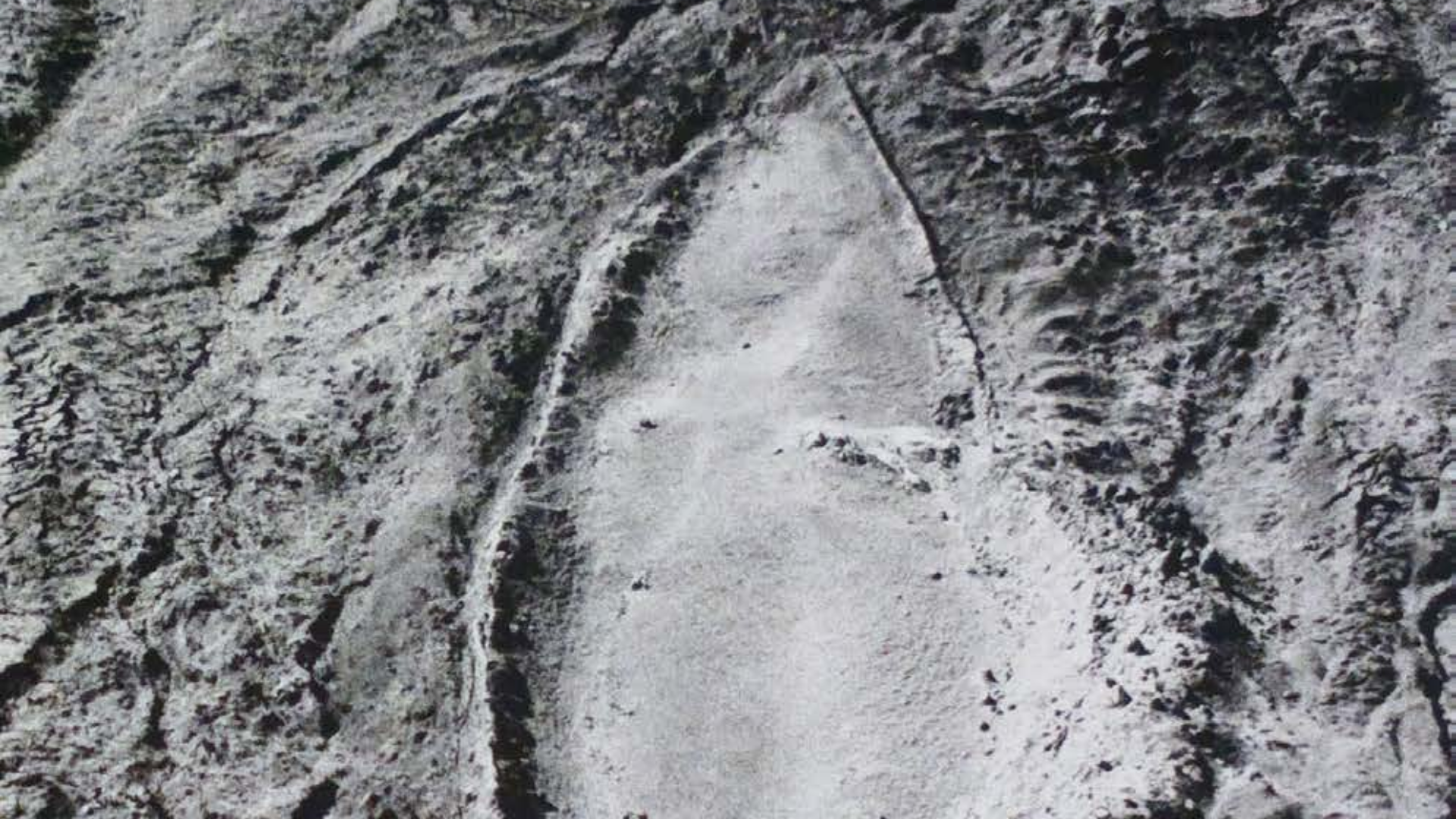
The starting point is the shape and the size. The formation runs about 515 feet long, close to the 300 cubits Genesis gives for the ark, and it sits roughly 18 miles south of Mount Ararat, inside the region Genesis names as where the ark came to rest. Jones calls that length one of the strongest points: a formation the right size in the right place.
From there, the team points to what their instruments have picked up below the surface. Ground-penetrating radar and electrical resistivity scans have, in their reading, turned up angular structures and regularly spaced features several meters down, including what they describe as a long central corridor running the length of the formation. Right angles, Jones argues, are uncommon in natural rock and point toward something built. "What else could it be?" he asks. "There's no water nearby" — his shorthand for the argument that the formation's shape and internal features are hard to explain by the ordinary forces, like water and mudflow, that skeptics point to.
The team also leans on soil chemistry. Soil scientist William Crabtree, part of the group, reports that samples taken inside the formation show markedly more organic matter than the ground around it. His argument is that decaying wood would raise organic content and alter the surrounding soil, and that this is roughly what the inside-versus-outside samples show.
Jones is aware of how this looks from the outside — a group of believers finding what they hoped to find — and points out that some of the key data wasn't collected by his own team. The 2019 radar survey was run by a professional crew brought in from America for a television documentary. "It's not like we're forcing the results," he said. He tells one story from that shoot often: a crew member who identified as an atheist was struck enough by the scans that he called his grandmother, a believer, to say he might be standing on the remains of Noah's Ark. Jones offers it not as proof, but as a sign the readings surprised even the skeptics in the room.
It's worth being clear about how the researchers themselves frame all this. They call it evidence worth investigating, not a settled finding. Jones has said plainly that the honest question is still open: is this something made, or an extraordinary natural formation? Their answer is that you find out by looking closer, which is what the current expedition is for.
The critics are not only secular scientists. Some of the most detailed pushback comes from fellow Christians, which is part of what makes this debate so tense at times, and unusual.
Geologist Dr. Andrew Snelling, writing for Answers in Genesis, raises both a geological and a biblical objection. On the geology, he notes that the rock within the structure is limestone, and that the corridor-and-cabin features the scans pick up could just as easily reflect natural jointing, layering, or a cave dissolved out of the limestone by groundwater. Any subsurface scan, he argues, requires interpretation, and interpretation tends to follow what the interpreter already expects to find.
His biblical objection is about location. Genesis 8:4 says the ark rested on the mountains of Ararat, and that the surrounding peaks weren't visible for another 74 days, implying a high resting place. The Durupinar formation sits in a valley on the southern slopes of a volcano. On both counts, Snelling argues, the site doesn't fit the text.
Answers in Genesis founder Ken Ham has echoed this, cautioning that geophysical scans shown in viral videos aren't peer-reviewed, and that Christians should be slow to stake claims on evidence skeptics can easily pick apart. He has urged fellow believers to "exercise caution, look at the actual evidence, and avoid arguments based on conjecture." His organization's position is that they'd love the ark to be found, but that a weak argument for the Bible does more harm than a missing one.
Others outside AiG have been sharper. Apologist Wesley Huff, called the recent findings "not legit" and rooted in "sensationalism and non-credible archeology," noting that the core team members aren't formally trained archaeologists and that ground-penetrating radar is easy to over-read. New Testament scholar Jeremiah Johnston went further, saying scholarly agreement that the site is not the ark is close to unanimous, and that radar is "famously inaccurate" in mountainous terrain. Both point out that boat-shaped formations occur elsewhere in the region, so a boat-like outline alone proves little.
The mainstream geological view predates this round entirely. As far back as 1996, geologist Lorence Collins co-published a paper concluding the formation is a natural feature, most likely a "syncline" — a fold in the rock — shaped by ordinary erosion. That has remained the majority position among geologists ever since.
Here's the honest truth: almost everything on both sides is an interpretation of indirect data. Radar returns, soil samples, and surface shape all have to be read, and so far none of it has been enough to settle the question either way. The researchers see corridors and the critics see limestone.
In an August 2026 press release, Noah's Ark Scans said it had deployed a specialized deep-ground radar across the formation and could not identify a clear bedrock boundary beneath it, which the team argues is hard to reconcile with the idea that the site is simply solid natural rock. However, even their own statement is careful to add that this isn't proof: the absence of a boundary in the data processed so far doesn't confirm bedrock is absent, and radar anomalies alone don't establish an archaeological origin.
But both sides agree on one thing: the only way to know for sure is to look directly at what's underneath. For Jones, that's exactly what the core drilling is for. "If it can core down under there and show layers that are not just natural geology," he said, "then that would be proof." He's equally frank about the limits of the debate as it stands. Archaeologists, he acknowledges, "always debate about everything," and the field works in "different degrees of certainty" rather than proof. His stated goal isn't to win the argument on scans, but to gather physical evidence and, in his words, "let everyone else decide."
And notably, the critics agree. Answers in Genesis has written the only way to settle the debate is eventually to examine the structure directly — work that has to be done carefully, non-destructively, and in full partnership with Turkish authorities, since the site is protected and sits in a politically sensitive border region. That's the same bar the current expedition says it's working under: radar and scanning first, then core samples, with permits and oversight in place. The team has also committed to publishing its results either way, which is the standard any honest search should be held to.
We're not here to tell you which side is right. Frankly, nobody reading an article can settle a sixty-year geological argument, and we're not going to pretend otherwise.
What's actually new isn't a conclusion. It's that, for the first time in decades, a team has the permits and the modern tools to go in and gather real data instead of trading interpretations of old scans. Noah's Ark Scans is running that effort, and their fundraiser to pay for the core drilling and surveys is live on GiveSendGo. You don't have to be convinced it's the ark to think a question people have argued about for this long is worth finally investigating.
GiveSendGo is a partner in this fundraiser.
Want to follow the expedition or help fund the work? Support "The Search for Noah's Ark" here.
Images courtesy of Noah’s Ark Scans’ website, fundraiser, and Facebook page.
A team called Noah's Ark Scans is now running a new round of surveys, scans, and for the first time, core drilling at the site, which has pulled the debate back into the open. Here's an honest look at both cases: what the researchers say they've found, and what credible critics say is wrong with it, laid side by side so you can decide for yourself.
We also had the opprotunity to speak with Andrew Jones, who founded and leads the research at Noah's Ark Scans, about the search later this year. Watch it here. The search is being funded by everyday people who want answers. To help fund "The Search for Noah's Ark," click here. GiveSendGo is a partner in this fundraiser.
The Case For
The starting point is the shape and the size. The formation runs about 515 feet long, close to the 300 cubits Genesis gives for the ark, and it sits roughly 18 miles south of Mount Ararat, inside the region Genesis names as where the ark came to rest. Jones calls that length one of the strongest points: a formation the right size in the right place.
From there, the team points to what their instruments have picked up below the surface. Ground-penetrating radar and electrical resistivity scans have, in their reading, turned up angular structures and regularly spaced features several meters down, including what they describe as a long central corridor running the length of the formation. Right angles, Jones argues, are uncommon in natural rock and point toward something built. "What else could it be?" he asks. "There's no water nearby" — his shorthand for the argument that the formation's shape and internal features are hard to explain by the ordinary forces, like water and mudflow, that skeptics point to.
The team also leans on soil chemistry. Soil scientist William Crabtree, part of the group, reports that samples taken inside the formation show markedly more organic matter than the ground around it. His argument is that decaying wood would raise organic content and alter the surrounding soil, and that this is roughly what the inside-versus-outside samples show.
Jones is aware of how this looks from the outside — a group of believers finding what they hoped to find — and points out that some of the key data wasn't collected by his own team. The 2019 radar survey was run by a professional crew brought in from America for a television documentary. "It's not like we're forcing the results," he said. He tells one story from that shoot often: a crew member who identified as an atheist was struck enough by the scans that he called his grandmother, a believer, to say he might be standing on the remains of Noah's Ark. Jones offers it not as proof, but as a sign the readings surprised even the skeptics in the room.
It's worth being clear about how the researchers themselves frame all this. They call it evidence worth investigating, not a settled finding. Jones has said plainly that the honest question is still open: is this something made, or an extraordinary natural formation? Their answer is that you find out by looking closer, which is what the current expedition is for.
The Case Against
The critics are not only secular scientists. Some of the most detailed pushback comes from fellow Christians, which is part of what makes this debate so tense at times, and unusual.
Geologist Dr. Andrew Snelling, writing for Answers in Genesis, raises both a geological and a biblical objection. On the geology, he notes that the rock within the structure is limestone, and that the corridor-and-cabin features the scans pick up could just as easily reflect natural jointing, layering, or a cave dissolved out of the limestone by groundwater. Any subsurface scan, he argues, requires interpretation, and interpretation tends to follow what the interpreter already expects to find.
His biblical objection is about location. Genesis 8:4 says the ark rested on the mountains of Ararat, and that the surrounding peaks weren't visible for another 74 days, implying a high resting place. The Durupinar formation sits in a valley on the southern slopes of a volcano. On both counts, Snelling argues, the site doesn't fit the text.
Answers in Genesis founder Ken Ham has echoed this, cautioning that geophysical scans shown in viral videos aren't peer-reviewed, and that Christians should be slow to stake claims on evidence skeptics can easily pick apart. He has urged fellow believers to "exercise caution, look at the actual evidence, and avoid arguments based on conjecture." His organization's position is that they'd love the ark to be found, but that a weak argument for the Bible does more harm than a missing one.
Others outside AiG have been sharper. Apologist Wesley Huff, called the recent findings "not legit" and rooted in "sensationalism and non-credible archeology," noting that the core team members aren't formally trained archaeologists and that ground-penetrating radar is easy to over-read. New Testament scholar Jeremiah Johnston went further, saying scholarly agreement that the site is not the ark is close to unanimous, and that radar is "famously inaccurate" in mountainous terrain. Both point out that boat-shaped formations occur elsewhere in the region, so a boat-like outline alone proves little.
The mainstream geological view predates this round entirely. As far back as 1996, geologist Lorence Collins co-published a paper concluding the formation is a natural feature, most likely a "syncline" — a fold in the rock — shaped by ordinary erosion. That has remained the majority position among geologists ever since.
Why It Isn't Settled
Here's the honest truth: almost everything on both sides is an interpretation of indirect data. Radar returns, soil samples, and surface shape all have to be read, and so far none of it has been enough to settle the question either way. The researchers see corridors and the critics see limestone.
In an August 2026 press release, Noah's Ark Scans said it had deployed a specialized deep-ground radar across the formation and could not identify a clear bedrock boundary beneath it, which the team argues is hard to reconcile with the idea that the site is simply solid natural rock. However, even their own statement is careful to add that this isn't proof: the absence of a boundary in the data processed so far doesn't confirm bedrock is absent, and radar anomalies alone don't establish an archaeological origin.
But both sides agree on one thing: the only way to know for sure is to look directly at what's underneath. For Jones, that's exactly what the core drilling is for. "If it can core down under there and show layers that are not just natural geology," he said, "then that would be proof." He's equally frank about the limits of the debate as it stands. Archaeologists, he acknowledges, "always debate about everything," and the field works in "different degrees of certainty" rather than proof. His stated goal isn't to win the argument on scans, but to gather physical evidence and, in his words, "let everyone else decide."
And notably, the critics agree. Answers in Genesis has written the only way to settle the debate is eventually to examine the structure directly — work that has to be done carefully, non-destructively, and in full partnership with Turkish authorities, since the site is protected and sits in a politically sensitive border region. That's the same bar the current expedition says it's working under: radar and scanning first, then core samples, with permits and oversight in place. The team has also committed to publishing its results either way, which is the standard any honest search should be held to.
Where GiveSendGo Comes In
We're not here to tell you which side is right. Frankly, nobody reading an article can settle a sixty-year geological argument, and we're not going to pretend otherwise.
What's actually new isn't a conclusion. It's that, for the first time in decades, a team has the permits and the modern tools to go in and gather real data instead of trading interpretations of old scans. Noah's Ark Scans is running that effort, and their fundraiser to pay for the core drilling and surveys is live on GiveSendGo. You don't have to be convinced it's the ark to think a question people have argued about for this long is worth finally investigating.
GiveSendGo is a partner in this fundraiser.
Want to follow the expedition or help fund the work? Support "The Search for Noah's Ark" here.
Images courtesy of Noah’s Ark Scans’ website, fundraiser, and Facebook page.
Comments
There are no comments yet. Be the first to add a comment below!
Leave a Comment
Fields with * are requiredGiveSendGo
The place where help and hope go hand-in-hand.
