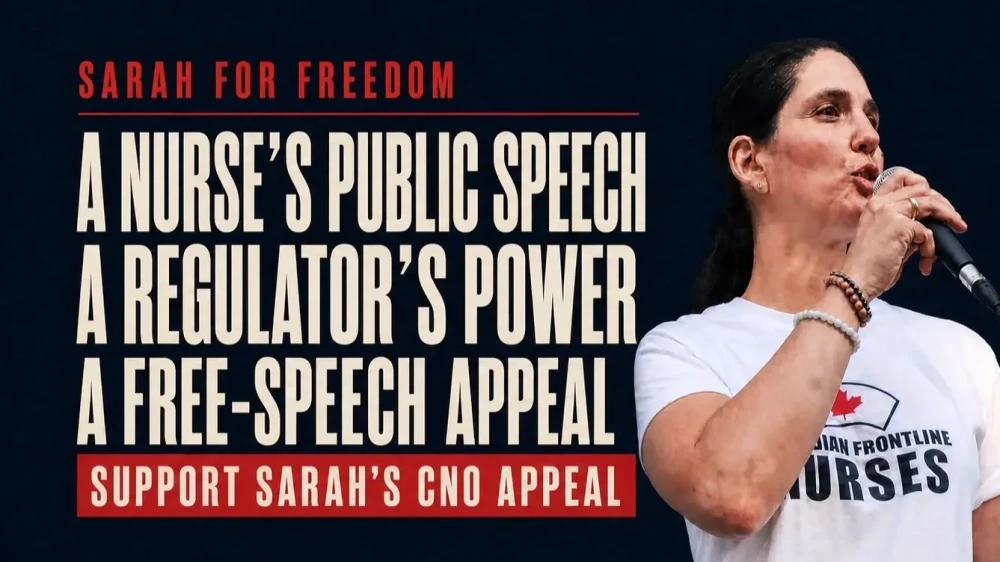
My name is Sarah Choujounian. I worked as an Ontario Registered Practical Nurse for more than a decade, caring for children with disabilities and residents in long-term care. I became a nurse because I believed in protecting patients, asking difficult questions, and speaking when something did not seem right.
During the COVID-19 pandemic, I spoke publicly about lockdowns, mandates, informed consent, and aspects of the public-health response. The College of Nurses of Ontario brought disciplinary allegations concerning twelve statements that I made or shared publicly in 2020 and 2021.
I spoke because I believed public officials and public-health institutions were presenting one account of the pandemic as settled while dismissing legitimate questions and contrary perspectives as misinformation. I questioned whether the risks of COVID-19 were being communicated in proportion to other serious public-health problems, whether fear-based messaging justified the harms associated with prolonged masking, lockdowns, isolation, and disrupted care, and whether uncertainty and changing evidence were being communicated honestly.
I was especially concerned about the pressure placed on Canadians—particularly healthcare workers—to accept the then-new mRNA vaccines as a condition of employment or participation in public life. To me, informed consent means being free to consider risks, benefits, alternatives, and uncertainty. It requires open discussion of different viewpoints and evidence as it evolves, not the promotion of only one authorized conclusion.
The liability hearing took place over 28 hearing days between March 2023 and December 2024. On March 13, 2026, a Discipline Committee Panel found that those statements were inaccurate, false and/or misleading, or encouraged non-compliance with public-health measures. It found that I had committed professional misconduct.
After a separate penalty hearing, the Panel ordered on July 6, 2026 that I be reprimanded, immediately revoked my nursing registration, and ordered me to pay $297,976.40 toward the College's legal costs and expenses. The penalty and costs order was issued without written reasons.
I am appealing these decisions to Ontario's Divisional Court.
This appeal is not simply about whether people agree with everything I said. It is about whether I received a fair hearing, whether the defence evidence was treated properly, and whether a nursing regulator can punish a nurse for speaking publicly without properly respecting her right to participate in public debate.
What the appeal is about
The appeal challenges the way the Panel dealt with the evidence the defence tried to present. My legal team argues that the Panel improperly restricted the opinion evidence of defence experts Dr. Steven Pelech and Dr. Byram Bridle, declined to permit Dr. David Speicher to testify as an expert, and excluded peer-reviewed literature that supported the defence position.
The appeal also challenges the Panel's conclusion that the twelve statements were inaccurate, false and/or misleading and that I encouraged non-compliance with public-health measures. It raises alleged errors of law, misapprehension of evidence, and procedural unfairness.
The appeal will ask the Court to consider the limits of professional regulation over public expression outside a clinical or nurse-client relationship. It argues that the Panel did not properly respect my freedom to speak and engage in public discourse, either when deciding liability or when imposing penalty.
These are grounds of appeal. They have not yet been decided by the Divisional Court, and no outcome can be guaranteed.
Why this matters
Nurses and other regulated professionals do not lose their right to participate in public debate. At the same time, regulators have an important responsibility to protect the public and maintain professional standards.
When those responsibilities come into conflict, the process must be fair. Relevant evidence must be treated according to law. The decision-maker must explain why a restriction on expression is justified and proportionate. Severe orders must be supported by reasons that permit meaningful review.
This appeal asks where those legal boundaries lie. Its importance extends beyond my registration. It may affect how regulators approach controversial public speech, how defence evidence is heard in professional-discipline proceedings, and whether professionals can question institutions without facing an unfair process.
Many Canadians remain skeptical about how the pandemic was managed and whether dissenting voices were too readily censored, dismissed, or silenced. Whatever one believes about the pandemic, professional discipline should not become a shortcut around fair process, open debate, or the right to speak freely.
I am not currently practising nursing and do not plan to return to clinical practice. I am pursuing this appeal because the decision should not stand unchallenged and because the legal principles matter to people far beyond me.
Why I need your help
After 28 days of liability hearings and a separate penalty hearing, the record is extensive. Bringing an appeal of this scale requires an enormous amount of careful work: reviewing hearing transcripts and exhibits, preparing the court record, researching and drafting the legal argument, paying filing and other disbursements, and preparing for the hearing before the Divisional Court.
Funds raised through this campaign will support the legal fees and disbursements required to prosecute the CNO appeal, including:
• organizing and reviewing the extensive hearing record and transcripts;
• reviewing the exhibits and rulings relevant to the appeal;
• legal research and preparation of the appeal factum;
• filing, court, and hearing expenses; and
• counsel's preparation for and attendance at the appeal.
Every contribution helps. If you cannot donate, please share this campaign, follow the case, and help other nurses and Canadians understand what is at stake.
I know that people have different views about the pandemic and the statements at issue. You do not have to agree with every view I have expressed to believe that a fair hearing, reasoned decision-making, and the freedom to participate in public debate matter.
Thank you for helping me ask the Divisional Court to decide whether the hearing was fair and whether my right to speak publicly was properly respected.
Sarah
For case updates and source documents, visit Sarah4Freedom.com — https://www.sarah4freedom.com/.
This campaign provides public information and advocacy concerning an ongoing legal proceeding. The appeal allegations described above remain to be adjudicated. Contributions support the CNO appeal legal fund; legal outcomes cannot be guaranteed.