

Blog
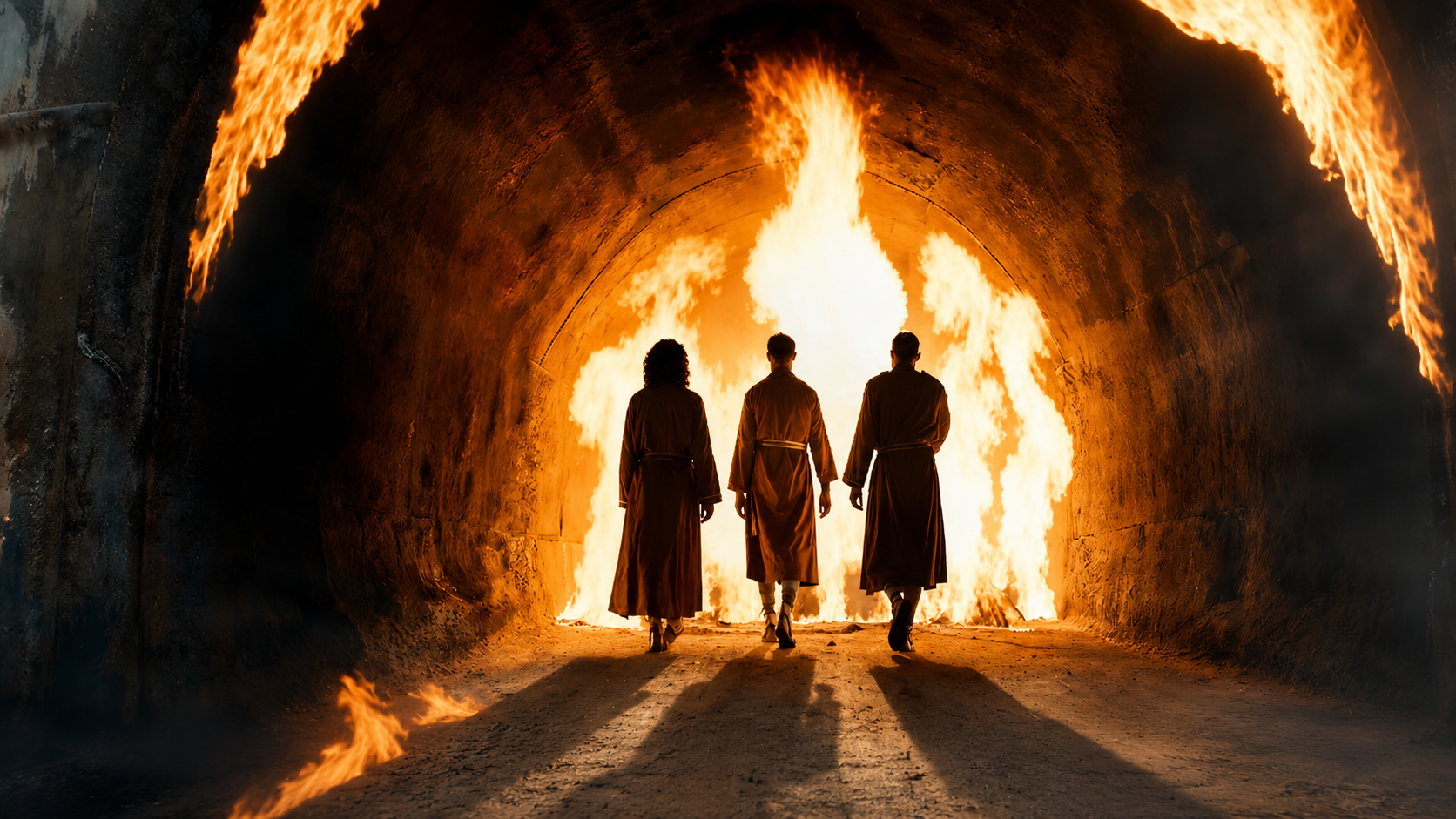
Shadrach, Meshach and Abednego: the Three Who Would Not Bow — and the Fourth Man in the Fire
Posted by Alex Shipley. Interview by Elijah Snider. on Aug 11, 2026
If you've spent any time in church (or watched VeggieTales as a kid), the story of the fiery furnace probably already rings a bell. It's one of those stories taught early and often enough that we assume we already know it, but the stories we think we know best from Sunday school are usually the ones where we've missed the most important, most overlooked details. This is one of those.
Strip away the felt board and what's left is a story of real faith in the middle of real adversity, where life or death actually hung on the answer three men gave a proud, furious king.
This story is now a major motion picture, Daniel and the Fiery Furnace, in theaters September 18. Through the movie's fundraiser on GiveSendGo, you can help send someone who couldn't otherwise afford to go. Give to Send Someone.
Before they had those names, they were Hananiah, Mishael, and Azariah — three young Hebrew men taken to Babylon along with Daniel after King Nebuchadnezzar conquered Jerusalem. Like Daniel, they were given new Babylonian names in the king's court: Daniel became Belteshazzar, and his three friends became Shadrach, Meshach, and Abednego.
They appear alongside Daniel early in the book, refusing the king's food and wine to stay faithful to their convictions. The food had likely been dedicated to Babylonian gods before it ever reached the table, and eating it would have meant honoring those gods along with the king. Daniel and his three friends chose not to defile themselves that way, wanting to stay fully faithful to the one true God, even in something as ordinary as a meal (Daniel 1:8–9). They trusted that their obedience would be met with God's own faithfulness, and it was: after ten days of eating nothing but vegetables and water, they looked healthier than everyone else in the king's training program (Daniel 1:12–16). God, pleased with their obedience, gave all four of them wisdom and understanding beyond their years, and gave Daniel specifically the ability to interpret visions and dreams (Daniel 1:17).
It’s worth remembering: these were likely very young men. The Kooman brothers, the filmmakers behind Daniel and the Fiery Furnace, made the same observation while researching this story for their film: "They were likely teenagers, young adults when they got to Babylon." These weren't seasoned men who'd faced down kings before. It's a story about people asked to make a decision most teenagers never have to: one that could cost them their lives.
By the time Nebuchadnezzar's golden statue goes up, all four men hold real positions in the Babylonian government. We may know Shadrach, Meshach, and Abednego mostly as Daniel's friends, but they weren't minor characters. Nebuchadnezzar himself said he'd found no one to compare to them in his entire kingdom.
Daniel 3 opens with Nebuchadnezzar building a gold statue about ninety feet tall on the plain of Dura, in the province of Babylon, and commanding that everyone bow to it the moment the royal music played. Refusal meant immediate death in a blazing furnace.
Shadrach, Meshach, and Abednego didn't bow. Certain Chaldeans, probably priests, who may have resented their standing, reported them to the king. Given one more chance to comply, the three men gave the answer that's become the center of the whole story: their God was able to deliver them from the furnace, and He would deliver them from the king's hand. "But even if he does not," they told the king, they still would not serve his gods or worship the statue he had set up (Daniel 3:16–18, NIV).
This is the question people ask more than almost any other, and the text actually gives a straightforward answer, even though it's easy to miss. Earlier in the book, after Daniel interpreted the king's dream, he asked Nebuchadnezzar to appoint his three friends over the administration of the province of Babylon, while Daniel himself remained at the royal court (Daniel 2:49). He simply held a different post, in a different place, by that point in the story.
But while Daniel most likely was elsewhere when this happened, we don't know for certain, and that uncertainty is part of why the filmmakers built some of the film's own tension around it. In their own words: "Because in the story with the three guys, they go into the fire and there's nothing really said about Daniel… But we know that if he was there with the guys, he would have bowed. That's something that we would have heard about, right? So he didn't bow, but why didn't he bow?" When asked if Daniel makes an appearance in this scene, one brother said, "I can't answer exactly what happens because I want you to check out what happens in the movie."
If there's a pattern to Nebuchadnezzar in this story, it's anger paired with urgency. His fury was moving faster than his judgment, burning about as untamed and wild as the fire he was about to command into being.
Because of the young men's refusal to bow down, Scripture says he had the furnace heated seven times hotter than usual. Whether that's a literal measurement or just the ancient world's way of saying "as hot as I can make it," the point is the same: this was a decision made in fury at the God they wouldn't abandon. That same hasty judgment is what led to what came next: his strongest soldiers bound the three men, fully dressed, and threw them in. The furnace was so hot that the soldiers who threw them in were killed by the heat on their way out (Daniel 3:19–22).
Then Nebuchadnezzar sees something that stops him mid-sentence. He asks his advisors whether they'd thrown three men into the fire, bound, because he can now see four men, unbound, walking around in the flames completely unharmed. The fourth, he says, looks like "a son of the gods" (Daniel 3:24–25). In other words, even he recognized this person as some kind of supernatural being.
Bible readers have debated exactly who that fourth figure was for centuries. Some see an angel sent to protect the other three. But the view most widely held is that this was a pre-incarnate appearance of Christ Himself. That reading leans on a pattern that shows up elsewhere in the Old Testament: the same figure many read as Jesus appears in human or angelic form and is treated as God Himself — the commander who accepts worship at Jericho (Joshua 5:13–15), and the Angel who appears to Gideon and is addressed as "the LORD" a few verses later (Judges 6:11–24).
Only Nebuchadnezzar didn't have the theological vocabulary to know what he was looking at. He only had his own polytheistic frame of reference to describe what he saw. But what he saw was still real: someone else was in the furnace with them.
When the king called them out and his officials examined them, they found the fire hadn't touched them at all: not a hair singed, not a robe scorched, and no smell of fire on them (Daniel 3:27). Anyone who's stood near a bonfire for ten minutes knows that smell clings to your clothes and even your hair for the rest of the day. These three men walked through a furnace heated past the point of no return, and came out without a trace of it.
Nebuchadnezzar made a decree that day that no one could speak against their God. But he wasn't ready to call Him the one true God, just another god worth adding to his collection, and it would take a much harder season for him personally before he finally acknowledged the God of Daniel as the one true King of heaven (Daniel 4:34–37). Still, that day he saw the fourth man in the fire may have been the beginning of his heart changing.
That's exactly why the Kooman brothers encourage you to invite your friends and family to watch Daniel and the Fiery Furnace with you. They hope many have this same heart and soul changing moment: "It gives me chills. I literally have chills right now to think about, what if the people that you bring to this movie experience what King Nebuchadnezzar experienced when they look into the furnace? What if they have that transformative life moment, or the beginnings of that, in their own life?"
God didn't stop the decree or keep Shadrach, Meshach, and Abednego out of the fire. He let them walk all the way into it, so He could walk with them through it, and that's the promise for you too: whatever you walk through, you don't walk through it alone.
Decades later, Daniel himself faced his own version of that same choice. Under a different king, Darius the Mede, he kept praying to God three times a day despite a decree forbidding it, and was thrown into a den of lions for it. He came out unharmed the next morning, having trusted, in his words, that his God had sent an angel to shut the lions' mouths (Daniel 6:22). The men who'd conspired against him were thrown in instead, and Darius, like Nebuchadnezzar before him, issued a decree honoring Daniel's God.
Two kings, two impossible death sentences, two moments where faithful people had no idea how it would end. It's worth wondering whether Daniel carried something into that lions' den that his three friends had given him decades earlier: not certainty that God would rescue him the same way again, but confidence that God was still the same God, and still good, either way.
"There's an ongoing battle for the soul of each person. There is a battle for whether you're going to choose faith over fear," the Kooman brothers said. "There will come a time where your beliefs will be challenged. And there'll be a time where you may face your own version of, say, the fiery furnace."
Shadrach, Meshach, and Abednego committed to faithfulness before they knew the outcome. "Even if he does not," they said, and meant it. Their obedience was never conditional on being rescued. Most of us treat God like a vending machine without meaning to: put in the right amount of faith, expect the outcome we want to come out the other side. They never made that trade. Whatever furnace you're facing, that's the faith worth asking God for: obedience and trust that is steadfast, and doesn't come with a return policy.
"Our prayer has always been that people would open the Bible because of this movie," the Kooman brothers have said. For anyone reading this who doesn't yet know the Lord, or hasn't placed their trust in Him, that's exactly the door this story is meant to open. "The way to a future in eternity," they said, "is through the fourth man in the fire."
This story is now the center of Daniel and the Fiery Furnace, opening in theaters September 18, 2026. Mena Massoud (Disney's live-action Aladdin) plays Daniel, and Elijah Alexander (Atticus in The Chosen) plays Nebuchadnezzar.
GiveSendGo is an Executive Producer on this film. Through the fundraiser on GiveSendGo, you can help send someone who couldn't otherwise afford to go. Through your generosity, you can make sure the price of a ticket doesn't have to decide who gets to see this story told.
Give to send someone and learn more.
Pastors and church leaders planning a group screening can find advance-screening details here.
Strip away the felt board and what's left is a story of real faith in the middle of real adversity, where life or death actually hung on the answer three men gave a proud, furious king.
This story is now a major motion picture, Daniel and the Fiery Furnace, in theaters September 18. Through the movie's fundraiser on GiveSendGo, you can help send someone who couldn't otherwise afford to go. Give to Send Someone.
Who Were Shadrach, Meshach, and Abednego?
Before they had those names, they were Hananiah, Mishael, and Azariah — three young Hebrew men taken to Babylon along with Daniel after King Nebuchadnezzar conquered Jerusalem. Like Daniel, they were given new Babylonian names in the king's court: Daniel became Belteshazzar, and his three friends became Shadrach, Meshach, and Abednego.
They appear alongside Daniel early in the book, refusing the king's food and wine to stay faithful to their convictions. The food had likely been dedicated to Babylonian gods before it ever reached the table, and eating it would have meant honoring those gods along with the king. Daniel and his three friends chose not to defile themselves that way, wanting to stay fully faithful to the one true God, even in something as ordinary as a meal (Daniel 1:8–9). They trusted that their obedience would be met with God's own faithfulness, and it was: after ten days of eating nothing but vegetables and water, they looked healthier than everyone else in the king's training program (Daniel 1:12–16). God, pleased with their obedience, gave all four of them wisdom and understanding beyond their years, and gave Daniel specifically the ability to interpret visions and dreams (Daniel 1:17).
It’s worth remembering: these were likely very young men. The Kooman brothers, the filmmakers behind Daniel and the Fiery Furnace, made the same observation while researching this story for their film: "They were likely teenagers, young adults when they got to Babylon." These weren't seasoned men who'd faced down kings before. It's a story about people asked to make a decision most teenagers never have to: one that could cost them their lives.
By the time Nebuchadnezzar's golden statue goes up, all four men hold real positions in the Babylonian government. We may know Shadrach, Meshach, and Abednego mostly as Daniel's friends, but they weren't minor characters. Nebuchadnezzar himself said he'd found no one to compare to them in his entire kingdom.
The Golden Statue and Nebuchadnezzar's Command
Daniel 3 opens with Nebuchadnezzar building a gold statue about ninety feet tall on the plain of Dura, in the province of Babylon, and commanding that everyone bow to it the moment the royal music played. Refusal meant immediate death in a blazing furnace.
Shadrach, Meshach, and Abednego didn't bow. Certain Chaldeans, probably priests, who may have resented their standing, reported them to the king. Given one more chance to comply, the three men gave the answer that's become the center of the whole story: their God was able to deliver them from the furnace, and He would deliver them from the king's hand. "But even if he does not," they told the king, they still would not serve his gods or worship the statue he had set up (Daniel 3:16–18, NIV).
Why Wasn't Daniel in the Fiery Furnace With Them?
This is the question people ask more than almost any other, and the text actually gives a straightforward answer, even though it's easy to miss. Earlier in the book, after Daniel interpreted the king's dream, he asked Nebuchadnezzar to appoint his three friends over the administration of the province of Babylon, while Daniel himself remained at the royal court (Daniel 2:49). He simply held a different post, in a different place, by that point in the story.
But while Daniel most likely was elsewhere when this happened, we don't know for certain, and that uncertainty is part of why the filmmakers built some of the film's own tension around it. In their own words: "Because in the story with the three guys, they go into the fire and there's nothing really said about Daniel… But we know that if he was there with the guys, he would have bowed. That's something that we would have heard about, right? So he didn't bow, but why didn't he bow?" When asked if Daniel makes an appearance in this scene, one brother said, "I can't answer exactly what happens because I want you to check out what happens in the movie."
Into the Furnace
If there's a pattern to Nebuchadnezzar in this story, it's anger paired with urgency. His fury was moving faster than his judgment, burning about as untamed and wild as the fire he was about to command into being.
Because of the young men's refusal to bow down, Scripture says he had the furnace heated seven times hotter than usual. Whether that's a literal measurement or just the ancient world's way of saying "as hot as I can make it," the point is the same: this was a decision made in fury at the God they wouldn't abandon. That same hasty judgment is what led to what came next: his strongest soldiers bound the three men, fully dressed, and threw them in. The furnace was so hot that the soldiers who threw them in were killed by the heat on their way out (Daniel 3:19–22).
So Who Is the Fourth Man in the Fire?
Then Nebuchadnezzar sees something that stops him mid-sentence. He asks his advisors whether they'd thrown three men into the fire, bound, because he can now see four men, unbound, walking around in the flames completely unharmed. The fourth, he says, looks like "a son of the gods" (Daniel 3:24–25). In other words, even he recognized this person as some kind of supernatural being.
Bible readers have debated exactly who that fourth figure was for centuries. Some see an angel sent to protect the other three. But the view most widely held is that this was a pre-incarnate appearance of Christ Himself. That reading leans on a pattern that shows up elsewhere in the Old Testament: the same figure many read as Jesus appears in human or angelic form and is treated as God Himself — the commander who accepts worship at Jericho (Joshua 5:13–15), and the Angel who appears to Gideon and is addressed as "the LORD" a few verses later (Judges 6:11–24).
Only Nebuchadnezzar didn't have the theological vocabulary to know what he was looking at. He only had his own polytheistic frame of reference to describe what he saw. But what he saw was still real: someone else was in the furnace with them.
They Came Out Without Even the Smell of Smoke
When the king called them out and his officials examined them, they found the fire hadn't touched them at all: not a hair singed, not a robe scorched, and no smell of fire on them (Daniel 3:27). Anyone who's stood near a bonfire for ten minutes knows that smell clings to your clothes and even your hair for the rest of the day. These three men walked through a furnace heated past the point of no return, and came out without a trace of it.
Nebuchadnezzar made a decree that day that no one could speak against their God. But he wasn't ready to call Him the one true God, just another god worth adding to his collection, and it would take a much harder season for him personally before he finally acknowledged the God of Daniel as the one true King of heaven (Daniel 4:34–37). Still, that day he saw the fourth man in the fire may have been the beginning of his heart changing.
That's exactly why the Kooman brothers encourage you to invite your friends and family to watch Daniel and the Fiery Furnace with you. They hope many have this same heart and soul changing moment: "It gives me chills. I literally have chills right now to think about, what if the people that you bring to this movie experience what King Nebuchadnezzar experienced when they look into the furnace? What if they have that transformative life moment, or the beginnings of that, in their own life?"
The Significance of the Fiery Furnace, and How It Ties Into Daniel and the Lions' Den
God didn't stop the decree or keep Shadrach, Meshach, and Abednego out of the fire. He let them walk all the way into it, so He could walk with them through it, and that's the promise for you too: whatever you walk through, you don't walk through it alone.
Decades later, Daniel himself faced his own version of that same choice. Under a different king, Darius the Mede, he kept praying to God three times a day despite a decree forbidding it, and was thrown into a den of lions for it. He came out unharmed the next morning, having trusted, in his words, that his God had sent an angel to shut the lions' mouths (Daniel 6:22). The men who'd conspired against him were thrown in instead, and Darius, like Nebuchadnezzar before him, issued a decree honoring Daniel's God.
Two kings, two impossible death sentences, two moments where faithful people had no idea how it would end. It's worth wondering whether Daniel carried something into that lions' den that his three friends had given him decades earlier: not certainty that God would rescue him the same way again, but confidence that God was still the same God, and still good, either way.
A Lesson for All of Us
"There's an ongoing battle for the soul of each person. There is a battle for whether you're going to choose faith over fear," the Kooman brothers said. "There will come a time where your beliefs will be challenged. And there'll be a time where you may face your own version of, say, the fiery furnace."
Shadrach, Meshach, and Abednego committed to faithfulness before they knew the outcome. "Even if he does not," they said, and meant it. Their obedience was never conditional on being rescued. Most of us treat God like a vending machine without meaning to: put in the right amount of faith, expect the outcome we want to come out the other side. They never made that trade. Whatever furnace you're facing, that's the faith worth asking God for: obedience and trust that is steadfast, and doesn't come with a return policy.
"Our prayer has always been that people would open the Bible because of this movie," the Kooman brothers have said. For anyone reading this who doesn't yet know the Lord, or hasn't placed their trust in Him, that's exactly the door this story is meant to open. "The way to a future in eternity," they said, "is through the fourth man in the fire."
Seeing It On Screen
This story is now the center of Daniel and the Fiery Furnace, opening in theaters September 18, 2026. Mena Massoud (Disney's live-action Aladdin) plays Daniel, and Elijah Alexander (Atticus in The Chosen) plays Nebuchadnezzar.
GiveSendGo is an Executive Producer on this film. Through the fundraiser on GiveSendGo, you can help send someone who couldn't otherwise afford to go. Through your generosity, you can make sure the price of a ticket doesn't have to decide who gets to see this story told.
Give to send someone and learn more.
Pastors and church leaders planning a group screening can find advance-screening details here.
Comments
There are no comments yet. Be the first to add a comment below!
Leave a Comment
Fields with * are requiredGiveSendGo
The place where help and hope go hand-in-hand.
